

 These pictures were taken during our last day-trip from Belgrade and the day before I was to fly back home. We had originally planned to drive with Miki to Avala, but he offered to drive us to Topola instead. Topola is the town where Karadjordje, the leader of the First Serbian Uprising against the Turks (1804), lived with his family before he had to go into exile. Oplenac hill is a complex which includes the amazing Crkva Svetog Djordja (church of Saint George), the building of which was planned by King Peter the First before WWI. This church is covered in mosaics, made from Murano glass in more than 35000 shades, which are copies of famous frescoes from monasteries in Serbia and Kosovo. It is a mausoleum where many members of the Karadjordjević family are buried. The site and the church are spectacular.
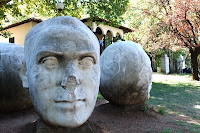
 Later that day we visited a small museum in Topola which used to be a Museum of the People's Liberation Struggle (1941-1945) but is now dedicated to the works of a local painter. The only remnants of this museum's former life is the beautiful sculptures in the museum garden depicting local WWII martyrs and famous local Partisans. The large marble heads are of four national heroes: Milan Blagojević, Milić Radovanović, Darinka Radović, and Sofija Ristić. They are by the sculptor Milija Glisić.
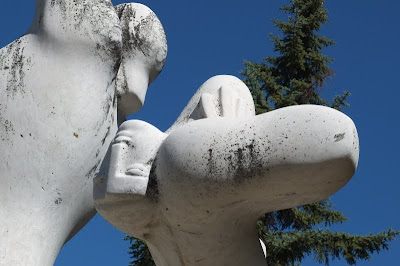
  The memorial to the mothers and daughters of Šumadija is by Ante Gržetić. It was originally conceived as a memorial to the national hero Darinka Radović and her two daughters Radmila and Stanka, who, according to my guide on Topola and Oplenac by M. Nedeljković published in 1989, were slaughtered by chetniks in 1943. Incredibly enough, the web page on Topola of the National Tourism Organization of Serbia makes no mention of any of these people. It however recommends to the visitor of Topola a “pampering body treatment at the Bukovicka Banja (spa) near Arandjelovac.”


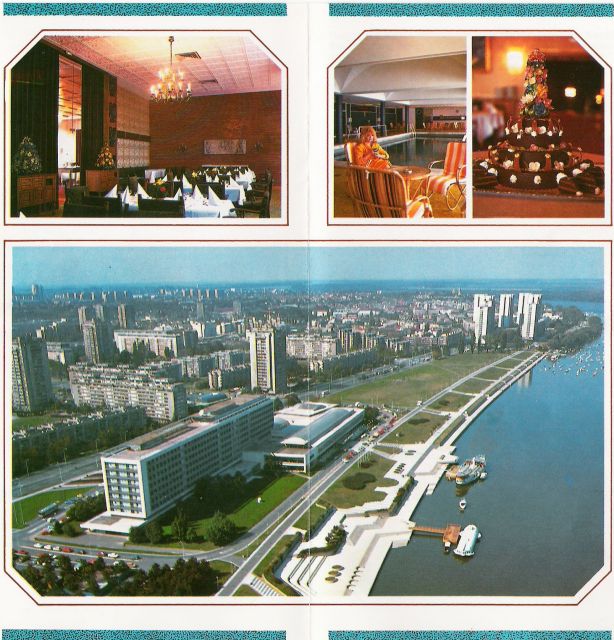
 On the plane back to New York I finally have time to replay some of our walks and to map them out. I now regret that we did not get to explore the neighborhood of New Belgrade called Ušće a bit more. The Belgrade Tourist guide from 1989 which I have in my hands makes me realize that "Brankov most" used to be called "Most Bratstva i Jedinstva'" (i.e. the Bridge of Brotherhood and Unity) which I find was a far more poetic and inspiring name. The term "Brotherhood and Unity" is of course indelibly associated with Tito's Yugoslavia and is therefore no longer kosher in today's Serbia. That every public remnant of Serbia's Yugoslav Socialist past has to be erased in this way is a bit sad.
I also regret not to have been able to visit the Contemporary  Art Museum (Musej Savremene Umetnosti Beograda) built in 1960-65 from a design by architects Ivan Antic and Ivanka Raspopovic, and which is currently closed. Sadly, the sculptures on the open space in front of it are covered in unappealing graffiti and the garbage cans are overflowing. If time had allowed, I would also have liked to walk to the site of Staro Sajmište (the Old Fairgrounds) which I recently read about. It was the location of the Semlin concentration camp in Nazi-occupied Serbia, built specifically for the internment of Jews, and where more than 7000 people died between March and May 1942 (including women, children and the elderly). The old guide mentions that in the former fair pavilions Belgrade painters now have their ateliers. Is this still the case more than twenty years later?
Park prijateljstva ("Friendship park") has managed to keep its poetic name.  In this park, starting in 1961, visiting heads of state and political dignitaries from all over the world used to plant a tree as a symbol of friendship with Yugoslavia. We will have to look for it on another visit but the tree-planting custom has most certainly died out.
The photos on this post were taken in New Belgrade, specifically in the Ušće neighborhood and on "Lido Beach" at the tip of the island called "Veliko Ratno Ostrvo" ("Great War Island"). The third picture from the top was taken near the Hotel Yugoslavija, once the most luxurious hotel in Belgrade, which was bombed by NATO in 1999 for reasons that remain unclear to this day. The hotel is awaiting renovation. The blog Nothing Against Serbia shows fascinating examples of Modernist Architecture in the former Yugoslavia.


 These pictures were taken during our last day-trip from Belgrade and the day before I was to fly back home. We had originally planned to drive with Miki to Avala, but he offered to drive us to Topola instead. Topola is the town where Karadjordje, the leader of the First Serbian Uprising against the Turks (1804), lived with his family before he had to go into exile. Oplenac hill is a complex which includes the amazing Crkva Svetog Djordja (church of Saint George), the building of which was planned by King Peter the First before WWI. This church is covered in mosaics, made from Murano glass in more than 35000 shades, which are copies of famous frescoes from monasteries in Serbia and Kosovo. It is a mausoleum where many members of the Karadjordjević family are buried. The site and the church are spectacular.
 Later that day we visited a small museum in Topola which used to be a Museum of the People's Liberation Struggle (1941-1945) but is now dedicated to the works of a local painter. The only remnants of this museum's former life is the beautiful sculptures in the museum garden depicting local WWII martyrs and famous local Partisans. The large marble heads are of four national heroes: Milan Blagojević, Milić Radovanović, Darinka Radović, and Sofija Ristić. They are by the sculptor Milija Glisić.
  The memorial to the mothers and daughters of Šumadija is by Ante Gržetić. It was originally conceived as a memorial to the national hero Darinka Radović and her two daughters Radmila and Stanka, who, according to my guide on Topola and Oplenac by M. Nedeljković published in 1989, were slaughtered by chetniks in 1943. Incredibly enough, the web page on Topola of the National Tourism Organization of Serbia makes no mention of any of these people. It however recommends to the visitor of Topola a “pampering body treatment at the Bukovicka Banja (spa) near Arandjelovac.”