
Belinda, thanks for lending me this great guide for Bosnia and Herzegovina! Also, thanks again to you and Elvir for the warm welcome and wonderful stay at your house in Sarajevo.
 Amra and Emina picked me up at the Tuzla Autobusna Stanica on Saturday at 1:45pm, where I arrived after a pleasant and uneventfult 3-hour-long bus ride from Sarajevo.
 One of the views from the Inspire d.o.o apartment where I am staying for the week that I will spend in Tuzla.
 Lake Tuzla, the artificial salt-water lake that was created after the closing of the adjacent salt mine. Salt gave Tuzla its name. A bit too early in the season to swim laps there

The new cemetery near lake Tuzla where seventy one young Bosnians are buried, who were killed by a shell thrown by the Army of Republica Srpska on a gathering of young people on May 25, 1995 (“youth day” in Bosnia), during the Bosnian war. All of the victims were civilians. This horrifying and incredibly saddening event is referred to as the Tuzla massacre. The funeral for these young men and women was held with torch lights, in secret at 1am.
 Monument to heroes of WW II. Emina is walking on a mosaic representing a pattern for a bosnian “kilim.”

A bust of a famous WWII hero, Josip Broz Tito (1892-1980).
 Day trip to Srebrenik on Sunday April 20th with friends and colleagues Amra, Senad and Ado from the Inspire Tuzla office. The town of Srebrenik is about 35 km from Tuzla. This old tourist map of the former Yougoslavia fails to mention Srebrenik as a point-of-interest.
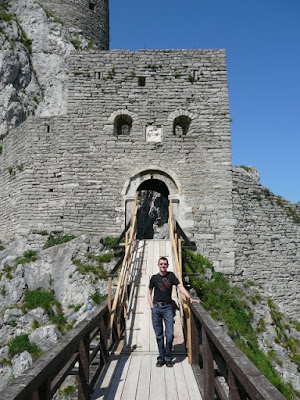

The spectacular Srebrenik fortress (“kastel”), built early in the fourteenth century.

Yet another truly magical Bosnian moment. Down the hill below, a Bosnian farmer is tilling his field with an old-fashioned hearse pulled by a white horse. As I was getting ready to take the picture, Senad said: "Arnaud, that guy down there is probably doing that just for you..."

 A small break before moving-on to Gradacac (to be continued...)


One of the typical haystacks found all over the Bosnian countryside.
 I arrived in Travnik on Friday night at the
  is only natural I should quickly pay a visit to the house where the master was born. The restaurant is only supposed to open at 11 and there is no sign of activity upstairs so I decide to come back later. When I come back at noon, the museum has been invaded by a boisterous group of teenagers from
  change for the worse if nothing is done). Adi is from Travnik. He recommends that I do not forget to visit the Kastel (Stari Grad) during my stay. We exchange email addresses and promise to stay in touch. After the Slovenian kids leave, I spend an hour in the museum looking at the various copies of the Bosnian Chronicle translated into many different languages. In another room, there is a display showing Andric receiving his Nobel prize for literature (the only writer from the former Yougoslavia to receive this honor). In a glass case, there are reproductions of letters written in French by the French consul in Travnik in the early years of the 19th century, whom the book is based on. I am like a kid in the proverbial candy store. When I am finally ready to leave, realizing that I am “vrlo gladan” (very hungry) I go downstairs for lunch (one of the best meals I’ve had in Travnik).


